Named bays and permits, with a fair, auditable waiting list. Crosstable governs the one layer parking software leaves on a spreadsheet — deciding fairly who among named people gets a scarce bay, and proving the decision.
A facilities or parking manager holds a lot of individually-addressed bays and assigns each to one permit holder — a corporate campus balancing return-to-office demand against far fewer spaces, a residential block with one numbered space per unit, a university running guaranteed tiers over colour zones.
Payment and enforcement are thoroughly digitised, and issuing a permit is a solved problem. What still lives on a spreadsheet is the allocation itself: a static list of forty names, no backup, deciding who gets the scarce bays — with documented waitlists running as long as thirteen years and oversell as high as three to one.
A static roster of names with no formulas lets two permits land on one bay — the "duplicate permits, mistyped plates" failure vendors describe verbatim.
The waitlist has no defensible order, so when someone is offered a bay out of turn there is no record of who decided or why.
Permit type and bay type drift apart — an EV permit on a non-charging bay, an accessible bay quietly let to someone who doesn't need it.
Move-outs and terminations don't revoke the bay, so occupied capacity is overstated and the next person waits longer than they should.
Each bay carries one active permit, and Crosstable refuses a second. The scarce bays carry a dated waiting list, and fairness lives in how out-of-turn offers are handled — never a silent edit; it takes the right permission and a written reason, and it's logged. The roster of eligible people is mirrored from the systems that already own it, and an issued permit is sent on to the plate allow-list and barrier, so the allocation stays authoritative without becoming a second source of truth.
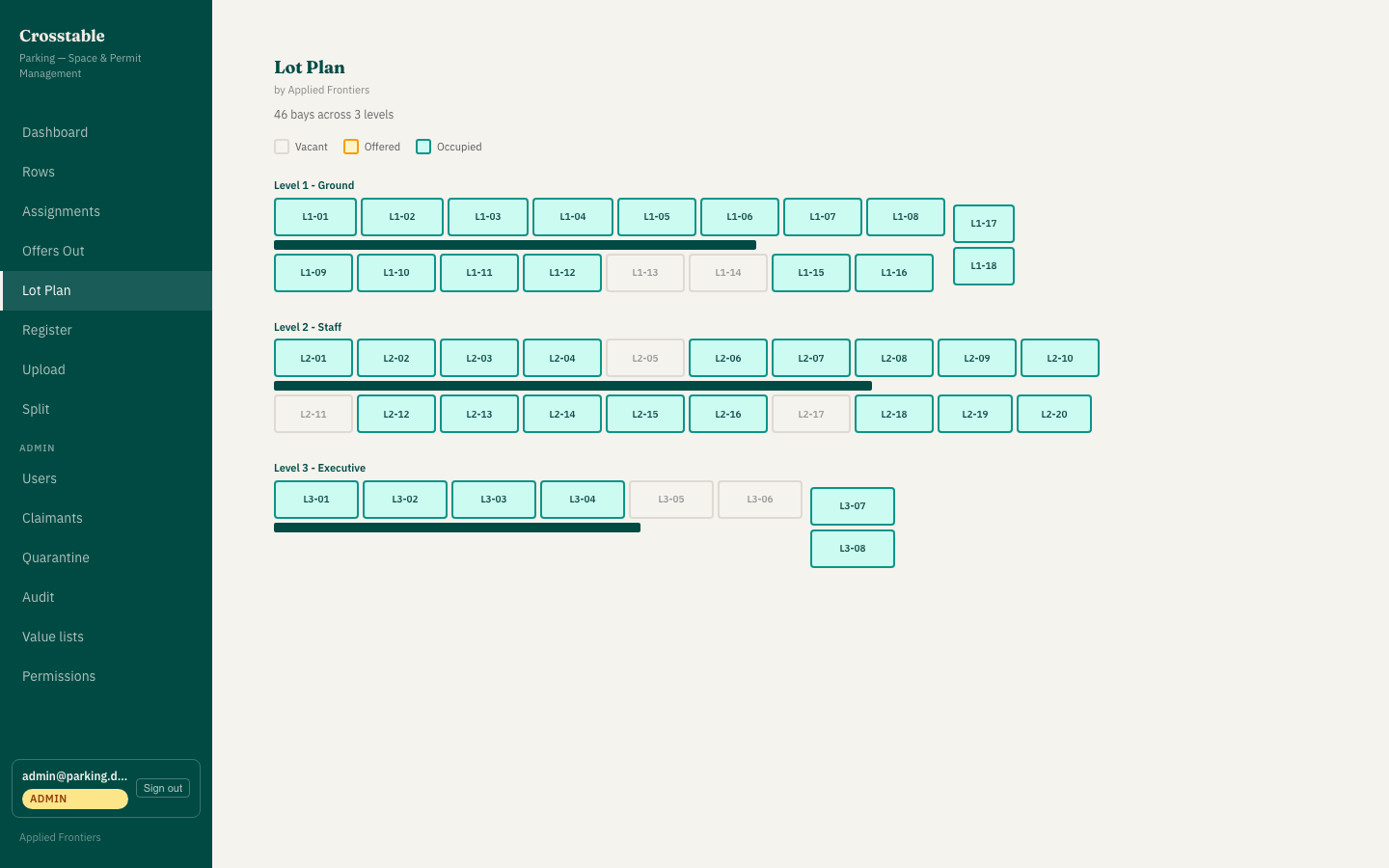
Bays positioned by level, row and side, coloured by live occupancy — vacant, offered, assigned — so the whole site reads at a glance.
Position is fixed by the date and time a request is made, with offer-and-respond windows and a decline lockout — the exact governance a scarce-bay dispute needs.
Skipping the queue is possible for a manager, but only as a permissioned, reason-logged exception that survives in the audit trail.
Workplace, campus and residential rosters stay in sync via SSO, SIS or the property-management system, revoking a permit automatically at move-out.
The issued permit is a generated document carrying holder, plate, zone entitlement and validity dates.
The core enforces one holder per bay and runs the dated queue. The rest is the setup conversation.
Oversold zone pools, where the pool limit sits above the physical bay count — a data value, not a rebuild.
The allocation algorithm and waitlist sort key — first-come, external seniority, lottery or fair-chance.
Strict permit-type to bay-type eligibility (EV to EV, accessible to accessible).
Accessibility and EV quota compliance against ADA or BS 8300 counts, as a reporting layer.
Overflow entitlement — a zone permit spilling into a fallback zone when its own is full.