Berths are let by the season and sublet by the week when owners cruise away — the same water is never promised twice. Crosstable allocates a fixed stock of berths against the one constraint a spreadsheet can't hold: a vessel, over dates, that has to physically fit.
A marina or harbour operator holds a fixed stock of individually-addressed berths ("C14", "D32") and allocates them to vessels owned by annual berth holders and passing visitors. A berth is scarce and individually numbered, wanted by competing parties over time, and each allocation becomes a signed berth licence — a promise to an outsider.
Today most small and mid-size operators run this on Excel, a paper dock plan and a whiteboard, where office, dock master, finance and — at public harbours — a governing board all touch different parts. Double-booking is a named, real failure, and the 2026 Guernsey waiting-list scandal made the cost of an unauditable allocation queue a matter of public record.
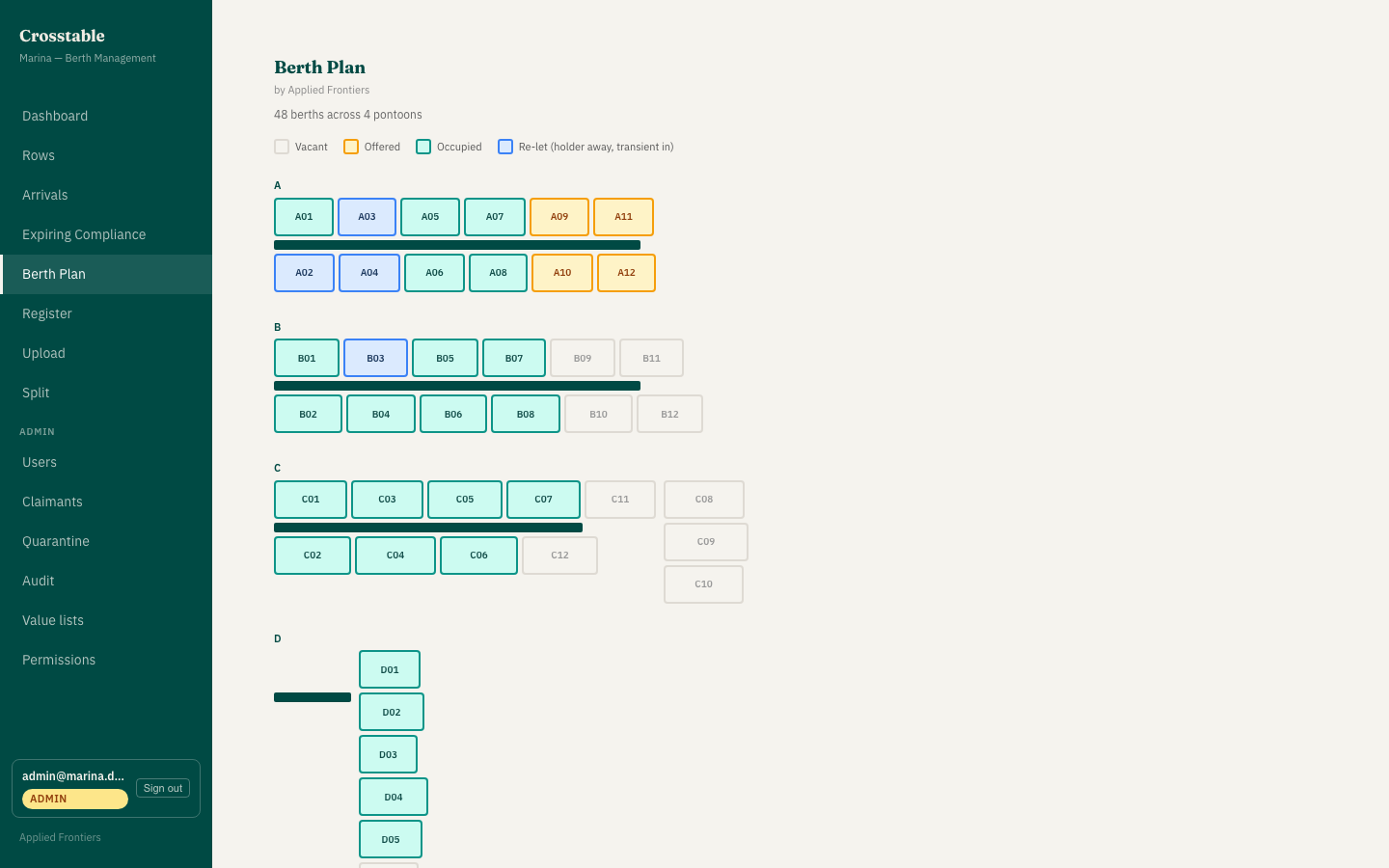
A season holder cruises away and the empty berth is let to a visitor — the sheet treats that as a clash, or worse, quietly double-books the return.
A 7.2 m boat is offered a 7.0 m finger because the cell holds a berth number, not the dimensions that actually have to fit.
The waiting list is a tab with 40 names and no rule — who was offered what, and why someone was skipped, lives in nobody's memory.
Insurance and safety certificates expire unnoticed, so a berth stays occupied by a vessel that no longer qualifies to be there.
The heart of it is simple: a berth is occupied over dates, and no two bookings may overlap — Crosstable refuses the clash rather than leaving it to etiquette. On top of that sit the things that make berths harder than a calendar: a full fit check on every offer, and absence re-letting, where an annual holder's empty weeks take visitor bookings that end before they return. Each allocation is a personal licence to a named vessel, so when the boat is sold the berth reverts rather than travelling with it.
Boats are drawn as hull shapes, scaled to their real LOA and beam, on the lettered-pontoon plan — the map the team actually works from, not a decoration.
The waiting list only offers a berth to an applicant whose vessel actually fits, so the queue reorders itself around physics instead of hope.
When an annual holder leaves to cruise, the empty weeks are let to visiting boats and the berth is back for their return — three distinct money flows kept separate from "cancelled".
A vessel keeps its berth only while its insurance (£2m inland / £3m coastal) and Boat Safety Scheme certificate are in date — tracked per vessel, with renewal-due warnings.
A berth allocation is a personal licence, not a lease — sell the boat and the berth comes back to the marina rather than travelling with the sale.
Crosstable covers what's true for every marina. The parts that are yours are the setup conversation — a change of settings, not software.
Your pricing structure — per-metre bands, multihull multiplier, seasonal tiers — carried on each allocation, with billing left to your finance system.
Local tidal and access rules: lock, sill, flap or drying berths with springs-vs-neaps windows.
Berth-numbering conventions and the governing local Act or byelaws.
Waiting-list policy — first-come, banded, or resident-priority — and your offer-lapse windows.
Compliance-regime selection by jurisdiction (inland vs coastal, trust port vs private).