One at a time

Exhibition booths

Stands held, contracted, confirmed — with a rebooking queue. Crosstable governs the allocation layer a slick public floor plan leaves on a spreadsheet: option-hold discipline, defensible priority ranking, and the audit trail behind every placement.

Exhibition booths in Crosstable
The operation

The operation

A show organiser owns the inventory — a hall divided into individually-numbered booths, each with a size, a type, a price zone and a status. A sales team works the interactive plan as its product catalogue, releasing priority exhibitors first and opening general sales later. Operations owns the master plan as a compliance document, signed off with the fire marshal.

The sell-side map is served by dedicated floor-plan software, but small and mid-size organisers frequently still run the allocation itself on Excel and a static CAD plan. What still runs on the sheet is the governance — priority-points ranking, the defensible rebooking queue, option-hold expiry, competitor-conflict checking — and shows lose a quarter to a third of their exhibitors each year, so a structured rebooking is worth real money.
The gap

Where the spreadsheet fails here

An option hold has no expiry discipline, so a "pencilled-in" stand sits unsold while a paying exhibitor is turned away.

The rebooking queue has no defensible order, so a priority-points dispute during the space draw comes down to whose email is quoted.

A competitor conflict caught late forces a cascade of reassignments across the whole plan.

Booth status (sold versus reserved) drifts from whether the deposit actually landed, because the CAD plan and the finance sheet are different documents.

The model

How Crosstable runs it

Each booth carries one active booking per edition, and a second is refused. Because a show sells per edition there are no overlapping dates to argue over — the real competition is the year-over-year rebooking cycle, which runs on the dated waiting list and its priority order, not on a calendar. Holds carry an expiry date so options genuinely lapse, and the whole journey runs on separated duties: sales holds, finance confirms the deposit, the director approves against priority rules, and operations checks the placement against the venue.

The rule
One active booking per booth, per edition — a second booking is refused.
The journey
Enquiry, option or hold, contract, deposit, confirmation, onsite — with the hold stage optional for "no-holds" shows.
Option expiry
A hold is only good for a set window — commonly 21 days — after which an unpaid, uncontracted stand flags overdue for release.
Rebooking queue
Returning exhibitors are offered next year's space first, in priority-point order, on the dated waiting list — out-of-turn offers are logged.
Placement authority
Operations checks every placement against venue fire and egress rules; the booking becomes binding only on the organiser's written acceptance.
Signature capabilities

Signature capabilities

The floor-plan map

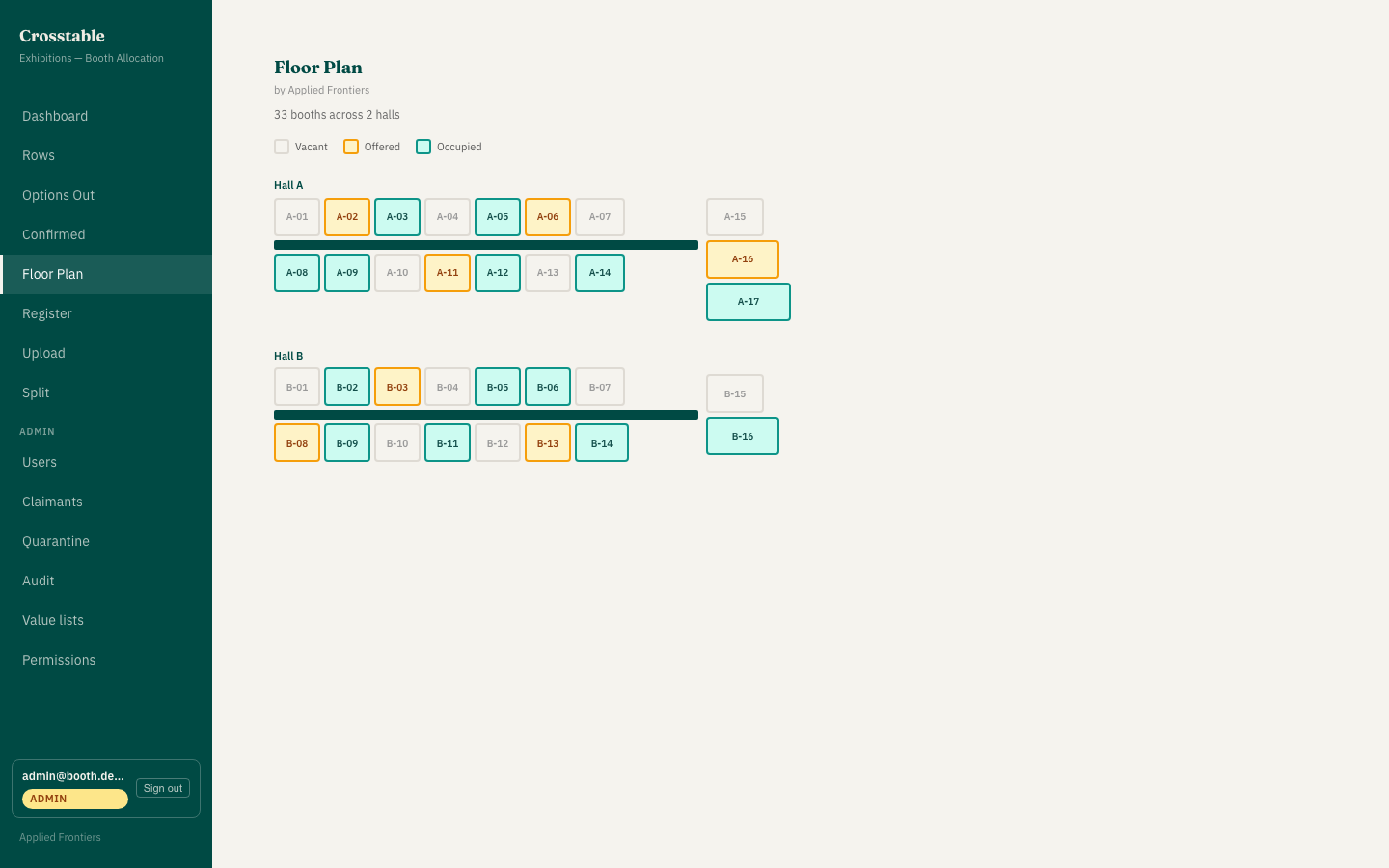
Booths positioned on the hall plan by aisle and row, coloured by live status, with type — inline, corner, peninsula, end-cap, island — carried on each.

Option-hold discipline

The tentative hold is a time-boxed stage, so "held as let for 21 days" is enforced automatically instead of forgotten.

The rebooking lounge, governed

The year-over-year space draw runs on the dated queue with reason-mandatory out-of-order allocation — exactly the artefact a rebooking dispute needs.

From enquiry to onsite

Enquiry through contract, deposit, confirmation and occupancy, each step resting on the real legal instrument — the Application and Contract for Exhibit Space.

Contract documents

The space contract and invoice are generated from the booking; sold status is gated on deposit receipt.

Configurable to your operation

Configurable to your operation

The core enforces one exhibitor per booth, runs the option-hold expiry and the rebooking queue. The rest is the setup conversation.

Competitor-adjacency conflict checks — a soft, overridable map warning, never a hard blocker, because every major show reserves override discretion.

Weighted priority-points scoring and ranked selection-window appointments.

Booth combination and splitting, with type reclassification and the corner / island / upper-deck surcharge table.

Category exclusivity sold as sponsorship — a hard lock on sales, tied to your product categories.

Co-exhibitor child records and fees, shell-versus-space height and structural-approval workflow, and the installment payment schedule.

Early access

See it on your show floor.